On Tuesday, we decide to rent a car and drive to Urbino. That sounds so easy, but first we take a train to Terontola, and the car agency there doesn't have any cars. They give us the number to try Hertz in Arezzo. Luckily they do have a car, so we get back on the train to Arezzo and wait until they arrive at the station with a Fiat Punto. Finally, two hours later, we are on the road. First we stop in Sansepolcro, the birthplace of Piero della Francesca, but after the debacle of the car rental we arrive smack in the middle of siesta, and nothing is open. We move on.
Amongst the many books we lugged abroad is an incredibly heavy book of Italian slow-food restaurants (locally sourced food, old methods of cooking). We don't have a guidebook to Umbria or the Marche, so we don't know anything about the towns we're passing, but we do know where we want to eat lunch, Osteria del Cucco in Urbania. So we leave Sansepolcro, and get on the road, which winds up a mountain and back down again. Although, it doesn't exactly wind. They obviously took the old donkey trail and just made it a road, so you have long straight-aways, and then a tight hairpin turn that requires almost a full stop. Unfortunately, again because we're just a bit behind schedule, we get to Urbania too late. The restaurant owner looks at us askance for wanting lunch at such a late hour. He sends us off to a pizzeria.

Sated, but now a bit grumpy, we drive to Urbino. We check out the Palazzo Ducale, which has a few Piero della Francesca paintings (now we feel a bit better about not seeing anything in Sansepolcro). It also has an amazing studiolo with inlaid wood used to create objects in perspective (trompe l'oeil). I've seen photographs of this room in the past, but before, without being able to stand in it and take it in all at once, the experience was somewhat lost. John and I spend a good deal of time in this room admiring the instruments, books, squirrel, armor, landscape, etc... all done in perspective with inlaid wood.
The best part, though, is that John gets a haircut. I guess he's been wanting to get it cut, but hasn't trusted the places in Passignano (with reason), and he figured that in a college town like Urbino he might get a cut that isn't too conservative. John tells everyone who walks into the salon while he's there that he came to Urbino to see the Palazzo and to get his hair cut by Marco. Everyone looks at him strangely until they realize he's joking. It's a good cut (the hairstylist kept saying "e un buon lavoro!" (it's a good job) over and over while cutting), and the whole trip is now a success.
The constantly circling birds, I have now learned, are swifts rather than swallows. If I knew my birds better, I would have recognized the v-shaped fork in the tail rather than the curved fork, but I only have a vague sense of birds (brown, black, little, noisy, etc...). I think bird recognition is a skill acquired later in life. Also, I can stop wondering why they seem to fly constantly with no clear destination- they are eating the bugs in the air. This made them, for a short while, my favorite birds in the world. But then I made a count of my mosquito bites, and now I think the swifts should be working a bit harder.
Italian mosquitoes are really preferable, I think, to American ones. Here they sneak up on you, and it isn't until much later that you realize you have another bite. Somehow I find that better because it means there's no point in being paranoid about being bitten. Once you feel the bite, it's way too late to worry about whether the mosquito is in the room. He might have left by now. Plus, they seem to prefer John just as much as me, which is rare. I have a feeling John prefers American mosquitoes....
We have a determined spider with no short-term memory that weaves a web over our door each night. I, of course, always forget and so have a daily creepy experience of walking through his web. He's probably figuring that since we're renters, we'll leave his house alone soon.
They say vipers and wild boars are rampant in these parts, but luckily I have only encountered spiders, mosquitoes and swifts.
Last night, as I left the house to pick up final things for dinner, I noticed Lake Trasimeno was slate grey, with a patchwork of small wind ripples running different directions. Looking up at the sky, I could see dark grey clouds. 20 minutes later, walking back in our front door, I heard the first rumble of thunder and got excited. I love summer rainstorms that arrive with flurry and bluster, real monsoons. Los Angeles tends to have rather mild rainstorms- rarely is there thunder or lightning, and I miss it.

John suggested we close the upstairs window, but I'm hoping that the rain will cool it down and don't want to lose the cross ventilation (see my attached drawing for a section of our house), . I decide to work by the upstairs window in case the wind starts blowing the rain sideways. 10 minutes later the storm gets louder. I look out the window, and halfway across the lake is a wall of white, and it's moving toward us. I yell for John to come help me close the window (it's a heavy steel one) and we get it closed just as the wall of water reaches us.
For the next half hour it alternates rain and hail, the wind blowing so hard that Lake Trasimeno looks like an ocean with waves. We unplug our computers and anything else nearby because of the thunder and lightning, and John goes around finding our flashlights and putting them in easy to find places (John knows Italian rainstorms better than I do, notice he suggested we close the window immediately...). But the storm passes uneventfully, and we slept wonderfully last night because it was a bit cooler.
 Keeping cadavers around is rarely practical. And if you were a medical student during the 18th and 19th centuries it was rare to witness a dissection. So many medical schools ordered wax models for students to learn about the body. One of the most well-regarded artists in this field was Clementi Susini, a portion of whose work is housed in Bologna's Palazzo Poggi. There you could see bodies built up from bone, to muscle, to skin, with partial models showing healthy kidneys versus failing ones, hearts, lungs.
But probably the largest part of the collection was devoted to showing difficulties with childbirth. If you are pregnant and live in a country that doesn't have C-sections, stop reading this. If you are pregnant and live in a country that does have C-sections, be really thankful for them. There were breach babies, babies that were backwards, babies where one arm exited first (just by looking at it you could tell that was a death sentence for mother and baby). They showed how a midwife's hand should enter the uterus to try and rotate a baby, and gruesomely, they showed the hand of a midwife that improperly entered, perforating the uterus and inevitably causing a mortal loss of blood for the mother.
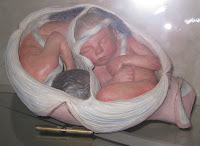
It was both horrifying and incredibly educational. I understand more about the human body during pregnancy than I probably ever wanted to know....
Today, as it was our last morning in Bologna, John decided he wanted to experience the craziness of San Luca's 4km arcade. So, for a second time, I made the trek. When we reached the beginning of the hill, though, we found that car traffic was being re-routed and people were gathering along the arcade to see something. We asked a gentleman what was going to happen, and he said, as we understood it, something about a motor race that was very historic. Great! We're here while there's a historic car or motorcycle race going on! So while walking up the arcade, we kept our ears and eyes peeled for the unmistakable sound of racing engines.
Pretty soon we heard the grumble of a motorcycle, and ran to the edge of the arcade, hoping to be there when the pack came around the corner of the adjoining street. But strangely, as it grew there was still the sound of only one motorcycle. Is it the head of the pack? One guy passes. He's not going as fast as I would expect. Perhaps he's just making sure the course is clear for the pack.
But soon another guy follows, also not going that fast, and this guy is at least 40 pounds overweight. Huh? And then we realize, this isn't a molto historico race (very historic), but a race of moto historicas (historic motorcycles). The bikes continue to pass, and now we can see that the bikes are really old. Some of the riders get into character for it, one dressing as an old soldier on a WWI army bike, some wearing the full leather outfit, but a few riders have a second person with them, and ar e clearly just out for fun on their old bike.
Bologna is the home of Ducati (as pointed out by my friend Sandy), so many of them were from that revered company. But we noticed that all the cops overseeing the course were on BMWs.
 This morning at 6:00am I woke up, and instead of rolling over to go back to sleep (we eat dinner until midnight here in Bologna), I started thinking maybe the morning would still be cool, and if I left now, maybe I could hike up to San Luca before it got too hot. Well, it was already hot this morning, but the hike to San Luca was worth it anyway.
First, you should know that Bologna is the city of arcades. Somebody built the first arcade during medieval times, and the town council thought it was a great idea, and pretty soon they started requiring it, even specifying the height so that riders on horseback could fit (which doesn't sound like such a great idea what with pedestrians and all, but I guess when it's hot even fancy people on horseback want to be covered). Walking through Bologna today you basically pass from one covered arcade to the next.
So I walk about a mile from our hotel, out through the old City gates, past cafe owners just beginning to set up, and finally get to the arcade of San Luca which snakes its way up the hill to the church on top. You can't see the church, all you see is a long arcade. I huff and puff my way to the end. Phew!
But then I get to the top and turn the corner... another long arcade, this one with stairs. Huff and puff. It's just me and the occassional jogger.
Turn another corner, the arcade stretches ahead. At the top a tiny figure appears, oh my gosh, he's so far away! It continues like this for a really, really, really long time. I had read that this was the world's longest arcade, but thought, "really, how long could that be?" Well, it's long, 4 kilometers (2-1/2 miles) long. It starts feeling like I'm in one of those nightmares where you're running down hallways that never end.
But it does end, at an unremarkable church at the top, and then I turn around and make my way back down, and actually enjoy the experience of the endlessness. It's like when I was a kid and I tried to imagine infinity. It was a great start to the day.
I just fell in love with the work of a Bolognese artist, Giorgio Morandi (born in Bologna in 1890). I'd never heard of him before, but went to check it out because my friend Josh insisted we see it (Josh comes every year for the Restored-Film Festival and so knows the City quite well).
It's free, so that was the first plus, and it's in an old palace with gently sloping stairs and a tall ceiling telling me the palace inhabitants didn't get off their horses until they were at the door of their chambers- worth it just for this so far. The first room has Morandi's early still lifes, from the 20's through the 30's. There is a studied akwardness to the arrangement of the objects, as though he is searching for some interesting relationship between them. Great, I like him.
And then I came to Natura Morta (still life) from 1948, where Morandi lines up the tops of all the objects in perspective, so his arrangement of things starts seeming like one thing. Very cool, and I really enjoy the work in this room.
Natura Morta 1957, the spaces between the objects starts to disappear. He has arranged them such that their lines are continuous, one piece melds into the next. You know there's space between them, but the objects read as though they've been compressed, your brain switches back and forth from seeing objects, to seeing a composition.

And by the 60's Morandi has reduced these compositions of objects into solid/void studies. I copied a drawing he does of an urn that clearly has two objects in front of it, but instead of drawing all the objects, he just draws the urn missing two chunks (see my copy of his drawing at right). Brilliant. He died two years later, and I wonder if it's because he was finally satisfied with the arrangement of the objects.